Division 2 Any Way to Listen to Portable Device Again
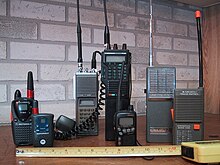
Recreational, toy and amateur radio walkie-talkies
A walkie-talkie, more formally known as a handheld transceiver (HT), is a mitt-held, portable, ii-style radio transceiver. Its development during the 2nd Globe War has been variously credited to Donald Hings, radio engineer Alfred J. Gross, Henryk Magnuski and engineering teams at Motorola. Outset used for infantry, similar designs were created for field arms and tank units, and after the state of war, walkie-talkies spread to public safety and eventually commercial and jobsite piece of work.[1]
Typical walkie-talkies resemble a phone handset, with a speaker built into one end and a microphone in the other (in some devices the speaker too is used as the microphone) and an antenna mounted on the top of the unit of measurement. They are held upwards to the confront to talk. A walkie-talkie is a one-half-duplex communication device. Multiple walkie-talkies use a single radio channel, and only 1 radio on the channel can transmit at a time, although any number tin listen. The transceiver is normally in receive mode; when the user wants to talk they must press a "push-to-talk" (PTT) button that turns off the receiver and turns on the transmitter. Smaller versions of this device are also very popular among immature children.
Some units have additional features such every bit sending calls, call reception with vibration alert, keypad locking, and a stopwatch.[two] [3]
History [edit]

A SCR-300 armed services backpack transceiver, nicknamed "walkie talkie"
Handheld ii-manner radios were developed by the military from backpack radios carried by a soldier in an infantry squad to go on the team in contact with their commanders. Probably the first patent possessor (patent filled on twenty May 1935, granted on 19 March 1936[4]) was an engineer from Poland Henryk Magnuski, who subsequently worked since 1939 on Motorola'southward commencement walkie-talkie (a hand-held radio transceiver SCR-536).[5] Canadian inventor Donald Hings was the first to create a portable radio signaling system for his employer CM&S in 1937. He called the system a "packset", although it subsequently became known equally a "walkie-talkie". In 2001, Hings was formally busy for the device's significance to the state of war effort.[half dozen] [7] Hings' model C-58 "Handy-Talkie" was in armed forces service by 1942, the result of a secret R&D effort that began in 1940.[8]
Alfred J. Gross, a radio engineer and one of the developers of the Joan-Eleanor organisation, likewise worked on the early on applied science backside the walkie-talkie betwixt 1938 and 1941, and is sometimes credited with inventing information technology.[ix]
The first device to be widely nicknamed a "walkie-talkie" was developed by the US armed services during World State of war 2, the backpacked Motorola SCR-300. Information technology was created past an engineering team in 1940 at the Galvin Manufacturing Company (forerunner of Motorola). The team consisted of Dan Noble, who conceived of the design using frequency modulation; Henryk Magnuski, who was the chief RF engineer; Marion Bond; Lloyd Morris; and Nib Vogel.[10]
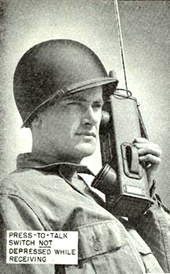
A SCR-536 Us military "handie talkie", the first paw-held walkie-talkie
The first handheld walkie-talkie was the AM SCR-536 transceiver from 1941, besides made by Motorola, named the Handie-Talkie (HT).[11] The terms are often confused today, but the original walkie-talkie referred to the back mounted model, while the handie-talkie was the device which could be held entirely in the hand. Both devices used vacuum tubes and were powered by high voltage dry cell batteries.
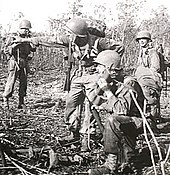
Post-obit Globe War Two, Raytheon developed the SCR-536's armed services replacement, the AN/PRC-six. The AN/PRC-vi circuit used 13 vacuum tubes (receiver and transmitter); a second set of 13 tubes was supplied with the unit as running spares. The unit was manufactory set with one crystal which could be changed to a unlike frequency in the field by replacing the crystal and re-tuning the unit. It used a 24-inch whip antenna. At that place was an optional handset that could exist connected to the AN/Cathay-6 past a 5-foot cable. An adjustable strap was provided for carrying and support while operating.[12]
In the mid-1970s, the United States Marine Corps initiated an effort to develop a squad radio to replace the unsatisfactory helmet-mounted AN/PRR-9 receiver and receiver/transmitter handheld AN/PRT-four (both developed past the US Regular army). The AN/PRC-68, first produced in 1976 by Magnavox, was issued to the Marines in the 1980s, and was adopted by the US Army besides.
The abbreviation HT, derived from Motorola'due south "Handie-Talkie" trademark[ commendation needed ], is commonly used to refer to portable handheld ham radios, with "walkie-talkie" often used equally a layman'due south term or specifically to refer to a toy. Public safe and commercial users generally refer to their handhelds merely equally "radios". Surplus Motorola Handie-Talkies plant their style into the hands of ham radio operators immediately following World War 2. Motorola's public safety radios of the 1950s and 1960s were loaned or donated to ham groups as part of the Civil Defense force program. To avoid trademark infringement, other manufacturers use designations such every bit "Handheld Transceiver" or "Handie Transceiver" for their products.
Developments [edit]
Some cellular telephone networks offering a push button-to-talk handset that allows walkie-talkie-like operation over the cellular network, without dialing a call each time. Withal, the cellphone provider must be accessible.
Walkie-talkies for public rubber, commercial and industrial uses may exist function of trunked radio systems, which dynamically allocate radio channels for more efficient use of limited radio spectrum. Such systems always piece of work with a base station that acts equally a repeater and controller, although individual handsets and mobiles may have a mode that bypasses the base of operations station.
Gimmicky utilize [edit]

A modern Project 25 capable professional walkie-talkie

Walkie-talkies are widely used in any setting where portable radio communications are necessary, including business organisation, public safety, military, outdoor recreation, and the like, and devices are available at numerous price points from inexpensive analog units sold as toys upwards to ruggedized (i.e. waterproof or intrinsically safe) analog and digital units for utilise on boats or in heavy manufacture. Nigh countries allow the auction of walkie-talkies for, at least, business organisation, marine communications, and some limited personal uses such as CB radio, also equally for amateur radio designs. Walkie-talkies, thanks to increasing use of miniaturized electronics, can exist fabricated very pocket-sized, with some personal two-mode UHF radio models beingness smaller than a deck of cards (though VHF and HF units can be essentially larger due to the demand for larger antennas and bombardment packs). In add-on, equally costs come down, it is possible to add avant-garde squelch capabilities such equally CTCSS (analog squelch) and DCS (digital squelch) (oft marketed as "privacy codes") to inexpensive radios, as well as voice scrambling and trunking capabilities. Some units (especially apprentice HTs) also include DTMF keypads for remote operation of various devices such as repeaters. Some models include VOX capability for easily-free operation, as well as the ability to attach external microphones and speakers.
Consumer and commercial equipment differ in a number of ways; commercial gear is mostly ruggedized, with metal cases, and frequently has only a few specific frequencies programmed into it (often, though not ever, with a reckoner or other outside programming device; older units can simply swap crystals), since a given business organization or public safety agent must oftentimes bide past a specific frequency resource allotment. Consumer gear, on the other mitt, is more often than not made to be small, lightweight, and capable of accessing whatever channel within the specified band, not just a subset of assigned channels.
Military [edit]
Military machine organizations utilise handheld radios for a diversity of purposes. Modern units such as the AN/Cathay-148 Multiband Inter/Intra Team Radio (MBITR) tin communicate on a variety of bands and modulation schemes and include encryption capabilities.
Apprentice radio [edit]
Walkie-talkies (also known equally HTs or "handheld transceivers") are widely used amidst amateur radio operators. While converted commercial gear past companies such every bit Motorola are not uncommon, many companies such as Yaesu, Icom, and Kenwood pattern models specifically for amateur utilise. While superficially similar to commercial and personal units (including such things every bit CTCSS and DCS squelch functions, used primarily to activate amateur radio repeaters), apprentice gear usually has a number of features that are not common to other gear, including:
- Wide-ring receivers, often including radio scanner functionality, for listening to non-amateur radio bands.
- Multiple bands; while some operate only on specific bands such as 2 meters or 70 cm, others support several UHF and VHF apprentice allocations available to the user.
- Since amateur allocations normally are non channelized, the user can dial in any frequency desired in the authorized ring (whereas commercial HTs normally only let the user to tune the radio into a number of already programmed channels). This is known as VFO mode.
- Multiple modulation schemes: a few amateur HTs may allow modulation modes other than FM, including AM, SSB, and CW,[13] [14] and digital modes such every bit radioteletype or PSK31. Some may take TNCs built in to support packet radio data transmission without additional hardware.
Digital voice modes are available on some amateur HTs. For instance, a newer addition to the Amateur Radio service is Digital Smart Technology for Amateur Radio or D-STAR. Handheld radios with this technology have several advanced features, including narrower bandwidth, simultaneous voice and messaging, GPS position reporting, and callsign routed radio calls over a broad-ranging international network.
As mentioned, commercial walkie-talkies can sometimes be reprogrammed to operate on amateur frequencies. Apprentice radio operators may practise this for toll reasons or due to a perception that commercial gear is more than solidly constructed or better designed than purpose-built amateur gear.
Personal use [edit]
The personal walkie-talkie has become pop as well because of licence-free services (such every bit the U.S. FRS, Europe's PMR446 and Australia's UHF CB) in other countries. While FRS walkie-talkies are as well sometimes used as toys considering mass-product makes them low toll, they have proper superheterodyne receivers and are a useful communication tool for both business organization and personal use. The blast in licence-gratis transceivers has, however, been a source of frustration to users of licensed services that are sometimes interfered with. For example, FRS and GMRS overlap in the The states, resulting in substantial pirate utilize of the GMRS frequencies. Apply of the GMRS frequencies (USA) requires a license; however most users either disregard this requirement or are unaware. Canada reallocated frequencies for licence-gratis use due to heavy interference from Us GMRS users. The European PMR446 channels fall in the middle of a United States UHF amateur allotment, and the US FRS channels interfere with public safety communications in the U.k.. Designs for personal walkie-talkies are in whatsoever case tightly regulated, generally requiring non-removable antennas (with a few exceptions such as CB radio and the United States MURS allocation) and forbidding modified radios.
Most personal walkie-talkies sold are designed to operate in UHF allocations, and are designed to be very compact, with buttons for changing channels and other settings on the face of the radio and a brusque, fixed antenna. Most such units are made of heavy, oftentimes brightly colored plastic, though some more expensive units accept ruggedized metallic or plastic cases. Commercial-grade radios are oft designed to exist used on allocations such as GMRS or MURS (the latter of which has had very piddling readily available purpose-built equipment). In addition, CB walkie-talkies are available, but less popular due to the propagation characteristics of the 27 MHz band and the general bulkiness of the gear involved.
Personal walkie-talkies are mostly designed to give easy access to all available channels (and, if supplied, squelch codes) within the device's specified allotment.
Personal two-way radios are also sometimes combined with other electronic devices; Garmin's Rino series combine a GPS receiver in the same package every bit an FRS/GMRS walkie-talkie (assuasive Rino users to transmit digital location data to each other) Some personal radios also include receivers for AM and FM broadcast radio and, where applicable, NOAA Weather Radio and like systems broadcasting on the same frequencies. Some designs also allow the sending of text letters and pictures between similarly equipped units.
While jobsite and regime radios are ofttimes rated in power output, consumer radios are ofttimes and controversially rated in mile or kilometer ratings. Because of the line of sight propagation of UHF signals, experienced users consider such ratings to be wildly exaggerated, and some manufacturers have begun printing range ratings on the package based on terrain as opposed to uncomplicated power output.
While the bulk of personal walkie-talkie traffic is in the 27 MHz and 400-500 MHz area of the UHF spectrum, in that location are some units that use the "Part 15" 49 MHz band (shared with cordless phones, babe monitors, and similar devices) every bit well every bit the "Part fifteen" 900 MHz ring; in the Usa at least, units in these bands do not require licenses equally long equally they adhere to FCC Part 15 power output rules. A company called TriSquare is, as of July 2007, marketing a series of walkie-talkies in the United states, based on frequency-hopping spread spectrum technology operating in this frequency range under the proper name eXRS (eXtreme Radio Service—despite the proper name, a proprietary design, not an official allocation of the US FCC). The spread-spectrum scheme used in eXRS radios allows up to 10 billion virtual "channels" and ensures private communications between 2 or more units.
Recreation [edit]

An inexpensive children's walkie-talkie
Low-power versions, exempt from licence requirements, are likewise popular children's toys such as the Fisher Price Walkie-Talkie for children illustrated in the peak paradigm on the right. Prior to the change of CB radio from licensed to "permitted by office" (FCC rules Part 95) status, the typical toy walkie-talkie available in N America was limited to 100 milliwatts of power on transmit and using i or two crystal-controlled channels in the 27 MHz citizens' band using amplitude modulation (AM) only. Later toy walkie-talkies operated in the 49 MHz band, some with frequency modulation (FM), shared with cordless phones and baby monitors. The lowest price devices are very simple electronically (single-frequency, crystal-controlled, generally based on a simple discrete transistor circuit where "grown-upwards" walkie-talkies use fries), may use superregenerative receivers, and may lack even a volume control, but they may yet be elaborately decorated, often superficially resembling more "grown-up" radios such as FRS or public prophylactic gear. Unlike more costly units, low-price toy walkie-talkies may not take divide microphones and speakers; the receiver's speaker sometimes doubles as a microphone while in transmit mode.
An unusual feature, mutual on children's walkie-talkies but seldom bachelor otherwise even on apprentice models, is a "lawmaking primal", that is, a button allowing the operator to transmit Morse code or similar tones to another walkie-talkie operating on the aforementioned frequency. Mostly the operator depresses the PTT button and taps out a message using a Morse Code crib sheet fastened every bit a sticker to the radio. However, as Morse Lawmaking has fallen out of broad apply exterior amateur radio circles, some such units either take a grossly simplified code label or no longer provide a sticker at all.
In addition, Family Radio Service UHF radios will sometimes exist bought and used as toys, though they are non generally explicitly marketed as such (just see Hasbro'south ChatNow line, which transmits both voice and digital data on the FRS band).
Smartphone apps & connected devices [edit]
A variety of mobile apps exist that mimic a walkie-talkie/Button-to-talk style interaction. They are marketed as low-latency, asynchronous communication. The advantages touted over two-way voice calls include: the asynchronous nature not requiring full user interaction (like SMS) and information technology is vox over IP (VOIP) and so information technology does not use minutes on a cellular plan.
Applications on the market that offering this walkie-talkie mode interaction for audio include Voxer, Zello, Orion Labs, Motorola Moving ridge, and HeyTell, among others.[15]
Other smartphone-based walkie-talkie products are made by companies similar goTenna, Fantom Dynamics and BearTooth, and offer a radio interface. Unlike mobile information dependent applications, these products work past pairing to an app on the user'due south smartphone and working over a radio interface.
Specialized uses [edit]

In addition to land mobile utilize, waterproof walkie talkie designs are also used for marine VHF and aviation communications, especially on smaller boats and ultralight aircraft where mounting a fixed radio might be impractical or expensive. Oftentimes such units will have switches to provide quick access to emergency and information channels. They are also used in recreational UTVs to coordinate logistics, keep riders out of the grit and are commonly continued to an intercom and headsets
Intrinsically safe walkie-talkies are frequently required in heavy industrial settings where the radio may be used around flammable vapors. This designation means that the knobs and switches in the radio are engineered to avoid producing sparks as they are operated.
Accessories [edit]
There are diverse accessories bachelor for walkie-talkies such as rechargeable batteries, drop in rechargers, multi-unit rechargers for charging as many equally six units at a time, and an audio accessory jack that tin be used for headsets or speaker microphones.[16] Newer models let the connectedness to wireless headsets via Bluetooth.
ITU classification [edit]
In line to the ITU Radio Regulations, article 1.73, a walkie-talkie is classified as radio station / land mobile station.
Meet also [edit]
- Mobile radio telephone
- AN/PRC-half dozen
- MOTO Talk
- Push button to talk
- Serval projection
- Signal Corps Radio
- Survival radio
- Vehicular advice systems
References [edit]
Footnotes [edit]
- ^ Christopher H. Sterling (2008). War machine Communications: From Aboriginal Times to the 21st Century. ABC-CLIO. pp. 504–. ISBN978-1-85109-732-6.
- ^ Stabo Freecomm 600
- ^ Stabo Freecomm 650
- ^ patent number 22972, Government Patent Office - 1936
- ^ Government Patent Office News - 1936, p.194 (in pdf page 14) patent number 22972 Urządzenie do szybkiego nawiązywania łączności radiotelegraficznej lub radiotelefonicznej. A device for a quick connexion establishing via radiotelegraphy or radiotelephony
- ^ http://world wide web.telecomhall.ca/bout/inventors/2006/donald_l_hings/WalkieTalkie.pdf?sourceid=navclient&ie=UTF-8&rls=GGLJ,GGLJ:2006-ten,GGLJ:en&q=Donald+Fifty.+Hings+. THE VANCOUVER Sun, Fri Baronial 17, 2001 Walkie-Talkie Inventor Receives Gild of Canada
- ^ "CBC.ca - The Greatest Canadian Invention". CBC News. Archived from the original on June 29, 2007.
- ^ "TM-11296 - Radio prepare AN/Cathay-6" (PDF). radiomanual.info. Dept. of the Army. Retrieved 13 January 2017.
- ^ "Al Gross". Lemelson-MIT Program. Retrieved 2018-ten-11 .
- ^ Niesel, John. "The SCR-300 Backpack Radio". warfarehistorynetwork.com. Sovereign Media. Retrieved 28 December 2018.
{{cite web}}: CS1 maint: url-status (link) - ^ Wolinsky, Howard (2003-09-25). "Riding Radio Waves For 75 Years, Motorola Milestones". Chicago Sun Times . Retrieved 23 March 2012.
- ^ "Radio set up AN/PCR-six" (PDF). VIRhistory.com . Retrieved 13 January 2017.
- ^ http://world wide web.rigpix.com/tokyohypower/ht750.htm Tokyo HyPower HT750
- ^ http://world wide web.rigpix.com/mizuho/mizuho_mx2.htm Mizuho MX2
- ^ Pogue, David (5 September 2012). "Smartphone? Presto! 2-Way Radio". The New York Times . Retrieved three Dec 2012.
- ^ "Ii Way Radios" page of IntercomsOnline.com.
Notations [edit]
- Onslow, David. "Ii-Way Radio Success: How to Choose Two-Way Radios, Commercial Intercoms, and Other Wireless Advice Devices for Your Business". IntercomsOnline.com. Retrieved 2008-10-24 .
Further reading [edit]
- Dunlap, Orrin E., Jr. Marconi: The man and his wireless. (Arno Press., New York: 1971)
- Harlow, Alvin F., Former Waves and New Wires: The History of the Telegraph, Telephone, and Wireless. (Appleton-Century Co., New York: 1936)
- Herrick, Clyde N., Radidselopments in Telecommunications 2nd Ed., (Prentice Hall Inc., New Jersey: 1977)
- Martin, James. The Wired Society. (Prentice Hall Inc., New Bailiwick of jersey: 1978)
- Silver, H. Ward. 2-Way Radios and Scanners for Dummies. (Wiley Publishing, Hoboken, NH, 2005, ISBN 978-0-7645-9582-0)
External links [edit]
- SCR-300-A Technical Manual
- U.S. Army Signal Corp Museum - exhibits and collections
Source: https://en.wikipedia.org/wiki/Walkie-talkie
0 Response to "Division 2 Any Way to Listen to Portable Device Again"
Post a Comment